
Investing in residential property and renting it out is a popular wealth-building path in India, especially in cities like Kolkata where property values are relatively affordable and demand for rentals is steady. But the key question every investor must answer is: What return am I getting — in percentage terms — on my investment?
In this detailed guide, you will learn:
Why ROI (Return on Investment) is a vital metric
The difference between gross vs net ROI, cash-on-cash returns, cap rates, etc.
The formulas and worked numerical examples
Real case studies from Kolkata neighborhoods
Mistakes to avoid, and practical tips to boost your returns
Let’s dive in.
Why ROI Matters for Rental Property Investors
When you put capital into buying a rental apartment, the ROI metric tells you how efficiently that capital is performing in generating rental income (and potential capital appreciation). It helps in:
Comparing different property investment options
Deciding if a rental returns more than alternative investments (stocks, fixed deposits, etc.)
Gauging whether your property is underperforming
Informing decisions on leveraging, renovation, rent hiking, or selling
Gross ROI vs Net ROI
Gross ROI / Gross Yield is a simpler, rough measure: it is (annual rent ÷ property cost) × 100. It ignores many expenses.
Net ROI (or Net Yield) subtracts operating expenses, vacancy costs, taxes, and so gives a truer picture.
Gross ROI is easier to compute and useful for a quick screening, but net ROI is what really counts for your cash returns.
Cash-on-Cash Return, Cap Rate & Other Metrics
Apart from ROI, several metrics are used by property investors:
Cap Rate (Capitalization Rate) = NOI ÷ property value
Cash-on-Cash Return = (Cash Flow After Debt Service) ÷ (Cash Invested)
Total Return / Holding + Sale Return = includes capital appreciation when you sell
Using all these together gives a robust assessment. (These are standard in real estate finance theory)
Key Components & Variables You Must Know
To compute ROI correctly, you must gather accurate figures for:
Rental Income (Gross & Effective)
Gross rent = the contracted rent (e.g. monthly rent × 12)
Effective rent = gross rent minus vacancy/discounts, free rent periods, or lost rent
For example, if you expect 1 month vacancy a year on a 12-month lease, effective rent is 11/12 of gross.
Operating Expenses & Vacancy Costs
Expenses incurred to keep the property functional and rentable, for example:
Maintenance, repairs, painting, plumbing
Property tax, municipal charges
Insurance
Management / broker fees
Utilities (if landlord pays)
Cleaning, pest control
Vacancy cost / tenant turnover
Capital expenditures (roof, electrical upgrade)
You must amortize occasional large expenses (capex) over multiple years rather than charging them fully in one year.
Initial Investment / Acquisition Costs
Your “investment base” includes:
Purchase price (or cost to build)
Stamp duty, registration, legal, agent fees
Renovation / repair costs to make fit for rent
Any furniture / fittings you provided
Ignoring acquisition costs can lead you to overestimate ROI.
Leverage, Loans & Financing Impacts
If you took a mortgage/loan, the interest, principal payments, and loan costs will affect your cash flows. Leverage can boost your returns (on your equity), but also increases risk. Many ROI variants (cash-on-cash) explicitly include financing effects.
Core ROI Formulas & Worked Examples
Let’s now look at the formulas and actual worked numbers. For clarity, we’ll denote:
RgR_g = gross annual rent
ReR_e = effective rent after vacancy
EE = total operating expenses (annual)
CC = total investment / cost base (purchase + fees + renovation)
CFCF = cash flow after debt (if financed)
Simple ROI (Unleveraged)
Formula & Step-by-Step
ROI (simple)=Re−EC ×100%\text{ROI (simple)} = \frac{R_e – E}{C} \;\times 100\%
If you ignore debt, that gives your return on your total investment.
Alternatively, Gross ROI = (Rg/C)×100%(R_g / C) \times 100\% — less precise, but useful for comparatives.
Example with a Kolkata Flat A
Suppose:
You buy a flat in Garia for ₹40 lakh (purchase price)
You pay ₹2 lakh in stamp duty, legal & agent fees
You spend ₹1 lakh on repairs & furnishing
So your total investment CC = ₹43 lakh
You expect:
Monthly rent ₹18,000 → gross annual rent RgR_g = 18,000 × 12 = ₹216,000
Vacancy for 1 month → effective rent ReR_e = 216,000 × (11/12) = ₹198,000
Annual operating expenses (maintenance, tax, insurance etc) E = ₹30,000
Then:
Simple ROI=198,000−30,0004,300,000×100% = 168,0004,300,000×100% = 3.91%\text{Simple ROI} = \frac{198,000 – 30,000}{4,300,000} \times 100\% \;=\; \frac{168,000}{4,300,000} \times 100\% \;=\; 3.91\%
So you get ~3.9% net return per year. If you used gross rent:
Gross ROI=216,0004,300,000×100%=5.0%\text{Gross ROI} = \frac{216,000}{4,300,000} \times 100\% = 5.0\%
This gives you a quick idea, but it overstates since expenses and vacancy are ignored.
Net Operating Income (NOI) & Cap Rate
Cap Rate Formula & Example
Cap Rate = NOIProperty Value×100%\frac{\text{NOI}}{\text{Property Value}} \times 100\%
Here, NOI = Re−operating expenses (excluding financing)R_e – \text{operating expenses (excluding financing)}.
Using the same example:
NOI=198,000−30,000=₹168,000NOI = 198,000 − 30,000 = ₹168,000
Property value = ₹43,00,000
So cap rate = (168,000/4,300,000)×100%≈3.91%(168,000 / 4,300,000) × 100\% ≈ 3.91\%.
Cap rate is often used by investors to compare properties (ignoring leverage).
Cash-on-Cash Return (Using Debt)
If you used a loan for part of the purchase, you look at your cash invested (equity), and the cash flow after debt service.
Formula & Example
Cash-on-Cash Return=CFEquity Invested×100%\text{Cash-on-Cash Return} = \frac{CF}{\text{Equity Invested}} \times 100\%
Where:
CF=Re−E−Debt Service (interest + principal)CF = R_e – E – \text{Debt Service (interest + principal)}
Equity Invested = your down payment + closing/repair costs financed by your own money
Example (continuing above):
Let’s say you borrowed 70% (₹30.1 lakh) at interest; you put down 30% = ₹12.9 lakh + acquisition costs ₹3 lakh = your equity = ₹15.9 lakh.
Assume annual debt service (interest + principal) = ₹100,000.
Then:
CF=198,000−30,000−100,000=₹68,000CF = 198,000 − 30,000 − 100,000 = ₹68,000
Equity = ₹15,90,000
So cash-on-cash return = (68,000/15,90,000)×100%≈4.28%(68,000 / 15,90,000) × 100\% ≈ 4.28\%
This can be higher (or lower) than the simple ROI based on leverage.
Total (Holding + Sale) ROI / Annualized ROI
If you plan to hold and later sell, you can compute the total return including capital appreciation.
Formula & Example
One formula:
Total ROI=(Rental Income Received Over Period+Sale Price−Sale Costs)−(C+Operating Costs Over Period)C×100%\text{Total ROI} = \frac{(\text{Rental Income Received Over Period} + \text{Sale Price} – \text{Sale Costs}) – (C + \text{Operating Costs Over Period})}{C} \times 100\%
To annualize that over nn years:
Annualized ROI=(1+Total ROI)1/n−1\text{Annualized ROI} = \left(1 + \text{Total ROI}\right)^{1/n} – 1
Example:
You hold the flat for 5 years. Rental net annual = ₹168,000 (as before) so over 5 years = ₹840,000
Operating & extra costs over 5 years = assume ₹40,000 extra = ₹200,000
Sale price after 5 years = ₹50 lakh (you sell)
Sale costs (broker, tax, etc) = ₹1 lakh
Then:
Gain=(840,000+5,000,000−100,000)−(4,300,000+200,000)=(5,740,000)−4,500,000=₹1,240,000\text{Gain} = (840,000 + 5,000,000 – 100,000) – (4,300,000 + 200,000) = (5,740,000) – 4,500,000 = ₹1,240,000
Total ROI = 1,240,0004,300,000=0.2884=28.84%\frac{1,240,000}{4,300,000} = 0.2884 = 28.84\% over 5 years
Annualized ROI = (1+0.2884)1/5−1≈5.2%(1 + 0.2884)^{1/5} – 1 ≈ 5.2\% per year
So your average annual return across rent + capital gain = ~5.2%.
Real‑Life Examples from Kolkata Neighborhoods
To make this concrete, here are illustrative (hypothetical but realistic) examples in Kolkata’s neighborhoods based on published rental yield data and property pricing.
According to Global Property Guide, Kolkata’s average rental yield is ~6.32% for apartments.
Also, different local blogs report yields in Salt Lake sectors at ~7–8%, and southern areas like Garia at ~5–6%.
Example in Salt Lake / Sector V
Purchase price: ₹8,000/sq ft, flat size 1,000 sq ft → total cost = ₹80 lakh
Acquisition + registration + legal fees = ₹4 lakh
Repairs / furnishing = ₹2 lakh
So total cost CC = ₹86 lakh
Rent: ₹50,000 / month → ₹6,00,000 annually
Vacancy: negligible (high demand area) → effective ~₹5,90,000
Operating costs: ₹70,000
Then:
NOI = 5,90,000 − 70,000 = ₹5,20,000
Gross ROI = (6,00,000 / 86,00,000) = 6.98%
Net ROI = (5,20,000 / 86,00,000) = 6.05%
Cap rate = 6.05%
If financed with 70% loan and you estimate debt service ₹1,50,000/yr and your equity = ₹25.8 lakh:
CF = 5,90,000 − 70,000 − 1,50,000 = ₹3,70,000
Cash-on-cash = 3,70,000 / 25,80,000 = 14.35%
You see how leverage can boost returns on your equity.
Example in New Town / Rajarhat
Purchase price: ₹6,000/sq ft, size 1,200 sq ft → ₹72 lakh
Acquisition + fees = ₹3 lakh
Repairs = ₹1.5 lakh
Total cost = ₹76.5 lakh
Rent: ₹35,000 / month → ₹4,20,000 annually
Vacancy: 1 month → effective = ₹3,85,000
Operating cost: ₹60,000
NOI = 3,85,000 − 60,000 = ₹3,25,000
Gross ROI = 4,20,000 / 76,50,000 = 5.49%
Net ROI = 3,25,000 / 76,50,000 = 4.25%
Cap rate = 4.25%
If financed 70%, debt service = ₹1,00,000 annually, equity = ₹22.95 lakh:
CF = 3,85,000 − 60,000 − 1,00,000 = ₹2,25,000
Cash-on-cash = 2,25,000 / 22,95,000 = 9.80%
Example in Garia / South Kolkata
Purchase price: ₹4,500 / sq ft, flat size 1,100 sq ft → ₹49.5 lakh
Acquisition + fees = ₹2 lakh
Repairs = ₹1 lakh
Total cost = ₹52.5 lakh
Rent: ₹20,000 / month → ₹2,40,000 annually
Vacancy: 1 month → effective = ₹2,20,000
Operating cost: ₹35,000
NOI = 2,20,000 − 35,000 = ₹1,85,000
Gross ROI = 2,40,000 / 52,50,000 = 4.57%
Net ROI = 1,85,000 / 52,50,000 = 3.52%
Cap rate = 3.52%
If financed 70%, debt service = ₹60,000 annually, equity = ₹15.75 lakh:
CF = 2,20,000 − 35,000 − 60,000 = ₹1,25,000
Cash-on-cash = 1,25,000 / 15,75,000 = 7.94%
These examples reflect how location, rent levels, cost, and leverage dramatically shift ROI outcomes.
Common Mistakes, Pitfalls & Adjustments
Even the best formula goes wrong if inputs are flawed. Some major pitfalls:
Ignoring Repairs, Maintenance & CapEx
Many owners forget to budget for periodic major expenses (roof repair, electrical upgrades). These must be amortized over years. Otherwise ROI is overstated.
Vacancy, Tenant Turnover & Rental Down Time
Expect some vacancy or time between tenants — you can’t assume 100% occupancy always.
Underestimating Taxes, Brokerage & Legal Costs
Closing costs, stamp duty, agent fees, property tax, insurance, legal expenses — all eat into returns.
Overleveraging & Interest Rate Risks
A property heavily leveraged is more sensitive to interest rate rises or rental dips. If your debt service becomes too high, cash flow might become negative.
Also inflation, regulatory changes (rent control laws, municipal charges) can shift the outcome.
Tips to Improve ROI / Rental Yield in Kolkata
If, as an investor, you want to maximize returns in Kolkata, here are actionable tips:
Choosing High-Demand Areas & Smaller Units
Smaller 1‑2 BHK units often generate higher per‑sqft rent and easier to lease. Areas like Salt Lake, Rajarhat, near IT hubs can command premium rents. According to a local blog, Salt Lake yields ~7–8%, East Kolkata ~6.5–7%.
Keeping Operating Costs Low
Negotiate bulk maintenance contracts, energy efficiency, using reliable materials, handling some tasks yourself, etc.
Regular Maintenance, Tenant Retention & Quality
A well‑maintained property retains tenants longer, reduces vacancies, and you can demand higher rent.
Periodic Rent Review & Market Trend Awareness
Monitor market rents in your area (colleagues list Salt Lake vs Alipore yields). Adjust your rent periodically to align with inflation and demand.
Also, monitor infrastructure developments (metro, road connectivity) which can increase capital appreciation.
Summary & Final Takeaways
ROI (return on investment) is the most essential metric for evaluating a rental apartment investment.
Always use net ROI (after expenses and vacancy) rather than just gross rent.
Don’t forget acquisition costs and periodic capital expenditures.
Leverage can increase returns on equity (cash-on-cash), but adds risk.
In Kolkata, yields vary: in prime Salt Lake you might approach 6–8%, while in peripheral or older areas yields often fall to 3–5%.
Use real examples and run sensitivity (if rent dips or vacancy increases, how much ROI is impacted).
Focus on high-demand areas, efficiency, maintenance, and smart tenant retention to maximize yield.
With disciplined financial modeling and realistic assumptions, you can compare property investments confidently and choose the best one for your capital.
Nature’s Paradise by Rupbasuda Developers — “Ready to Move” Plots



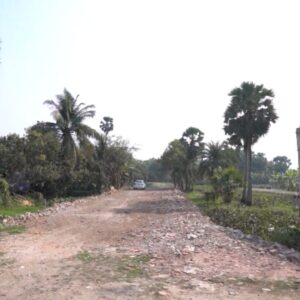
After covering what to check, here is detailed, well‑organized information about Nature’s Paradise, a township project by Rupbasuda Developers, to help you evaluate whether it meets those criteria and whether it might be a good option for you or others.
Project Overview
| Feature | Details |
| Project Name | Nature’s Paradise |
| Developer | Rupbasuda Developers |
| Location | Khariberia, Bhasa, Joka, Kolkata |
| Highway / Road | Along Diamond Harbour Road, National Highway 117 |
| Distance from Joka Metro | Approx 2.6 km |
| Time from Swaminarayan Temple | About 7 minutes |
| Nearby Landmark | Beside Palm Village Resort |
Plot Size, Type & Pricing
| Parameter | Details |
| Spread of Project | ~ 350 bighas of land area |
| Minimum Plot Size | 2 katha minimum purchase |
| Other Sizes Available | 3 katha, 5 katha, and more; no fixed maximum limit specified |
| Types of Plots | Premium & non‑premium; Residential & Commercial |
| Price Range | ₹1,30,000 (1 lakh 30 thousand rupees) up to ₹4,00,000 (4 lakh rupees) depending on plot size, location, type etc. |
Amenities & Infrastructure
| Amenity / Infrastructure | Present or Planned |
| Plot Status | Ready to move plots – so basic land preparation is done |
| Roads | Internal by‑roads of 25 ft & 20 ft; the approach roads being/will be four‑lane |
| Water supply | 24×7 water supply planned / provided |
| Electricity | Electricity connection available / planned |
| Drainage / Sewage | Proper drainage system in place or planned |
| Community & Recreational Facilities | Gymnasium, Clubhouse, Lake, Kindergarten School, Saraswati Temple |
| Transport | 24×7 transportation; metro station planned by end of 2028; nearby railway station etc. |
| Nearby Essential Facilities | Hospitals, Vegetable Market, Shopping Malls, Schools, Colleges just minutes away |
Location Advantages & Growth Potential
- Close proximity (2.6 km) to Joka Metro adds value and future ease of commute.
- Diamond Harbour Road (NH‑117) is a major route; improved highways/roads often lead to value appreciation.
- Many well‑known apartment projects in the vicinity (Emami Astha, Godrej Seven Elevate, Gems Bouganvilla, DTC Sojan, Eden Amantran, Solaris, Rajat by Avante etc.), often priced in crores, which suggests the area is already drawing premium development.
Payment & Booking Terms
| Parameter | Details |
| Booking Token Amount | ₹11,000 required as token booking amount |
| Payment Options | 36 months 0% interest EMI available |
| Developer / Agent | Dedicated Real Estate, with office near Thakurpukur 3A Bus Stand, Kolkata |
Potential Pros & Things to Check
Pros:
- Affordable entry point for middle class — both residential and commercial plots in the stated price range.
- Ready to move status reduces waiting time; some infrastructure already in place.
- Strong potential for appreciation because of upcoming metro, highway road works, location.
- Amenities are planned; community features suggest a self‑contained township rather than isolated plots.
Things you should still verify (using the checklist above):
- Confirm zoning status and whether NA conversion (if needed) has been done.
- Check encumbrance certificate to ensure clear title.
- Ensure all NOCs, permissions, layout plan approvals are legal and in order.
- Physical ground check: slope, drainage, whether land is flood‑prone.
- Exact road access: condition of roads, whether approach to your plot is via public road.
- Surrounding environment: whether neighbouring plots are being developed, quality, types of constructions.
- Utility access and readiness: water, electricity, sewage.
- Confirm any government notifications/plans that may require surrendering land or affect use.
Why This Might Be The Best Time to Buy
- With metro station planned by end of 2028, road improvements, and area being developed, plots may gain significant capital appreciation.
- Since many high‑end projects in the area are already valued in crores, a plot bought now at a few lakh rupees can deliver large value growth in coming years.
- Entry‑level price and flexible payment (0% EMI over 36 months) reduces the financial burden and risk.
How to Proceed (if Interested)
- Arrange a site visit to Nature’s Paradise. Survey multiple plots; compare premium vs non‑premium.
- Bring along a legal expert to verify documents.
- Ask developer / Dedicated Real Estate for copies of title deed, NA conversion (if applicable), EC, layout plan, approved plan, NOCs etc.
- Check the condition of internal roads, availability of utilities.
- Discuss payment schedule, any additional charges.
Contact Details
Dedicated Real Estate
- Phone: +91 6291422636
- Email: info@dedicatedrealestate.in
- Website: www.dedicatedrealestate.in
Office Location: Near Thakurpukur 3A Bus Stand, Kolkata